Customer support didn’t break overnight.
It broke slowly as stores added more channels, more volume, and more complexity without changing the underlying system.
Email here. Chat there. Maybe a helpdesk. Sometimes a phone line that no one wants to answer.
On the surface, everything looks “set up.”
Underneath, it’s fragmented, manual, and hard to scale.
That’s why response times slip. Agents repeat the same work. Customers follow up again and again.
This is exactly where modern AI customer support tools for Shopify start to replace repetitive workflows with structured automation.
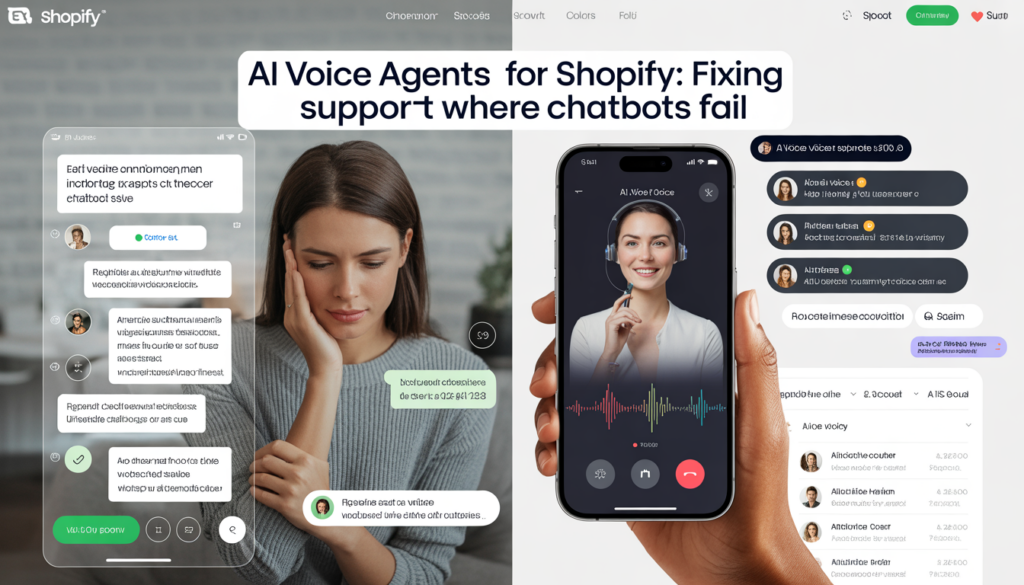
AI voice agents solve a different layer of this problem.
Not by adding another channel but by restructuring how inbound support actually works.
This article breaks down what AI voice agents are, where they fit in Shopify support, and when they become necessary.
Why Shopify Support Systems Break
Most stores don’t design support systems.
They react to problems.
- More tickets → hire more agents
- More channels → add more tools
- More complexity → add more steps
Nothing connects properly.
Most brands don’t have a unified Shopify support automation stack, which is why tools stay disconnected and inefficient.
So the same question travels across:
- Live chat
- Phone
- Social
And gets handled manually every time.
The core issue isn’t volume.
It’s repetition without structure.
The Reality of Support Volume
A large percentage of support requests are predictable:
- Where is my order
- Can I return this
- Why did my payment fail
- Can I change my address
These aren’t edge cases. They’re the majority.
Yet in most setups, every one of these still requires:
- A human to read
- A manual lookup in Shopify
- A typed response
- A follow up if needed
Multiply that across hundreds of tickets.
This is where Shopify customer support automation becomes necessary, not optional.
That’s where systems start to fail.

Current Approaches (And Their Limits)
1. Manual Support
This is the default starting point.
Agents handle everything directly.
What works
- Full control
- Flexible responses
What breaks
- Slow response times
- High cost per ticket
- Not scalable
Manual support works early. It doesn’t hold under growth.
2. Chatbots
Most brands try chatbots next.
They handle simple questions through pre written flows.
What works
- Quick replies for basic FAQs
- Reduces some ticket volume
What breaks
- Limited understanding
- No real access to Shopify data
- Fails on anything slightly complex
- Often pushes customers back to humans
Chatbots don’t remove the workload. They filter it slightly.
If you look at real Shopify support ROI and benchmarks, the efficiency gains from chatbots alone are often limited.
3. Helpdesk Systems
Helpdesks organize support.
They don’t resolve it.
What works
- Ticket management
- Internal workflows
- Reporting
What breaks
- Still human dependent
- Repetitive tasks remain manual
- Response speed tied to team size
Helpdesks improve structure but not efficiency at scale.
The Missing Layer: System Level Automation
Here’s what most setups lack:
A system that can:
- Understand the question
- Access Shopify data
- Resolve the issue automatically
- Escalate only when needed
Not assist humans. Replace repetitive steps.
This is where an AI Voice Agent comes in.

What Is an AI Voice Agent (In Shopify Context)?
An AI voice agent handles inbound phone support.
Not as a call router. Not as a script.
As a system that can:
- Answer customer calls
- Understand intent
- Access Shopify data
- Resolve structured queries
- Escalate complex issues
Important distinction:
Consio is not a chatbot.
You can explore all Consio AI products to understand how it fits into a broader support system.
That means it operates in a channel where urgency is highest phone calls.
Why Phone Still Matters
When something is urgent, customers don’t open chat.
They call.
Common triggers:
- Order didn’t arrive
- Payment failed
- Delivery issue
- High value purchase hesitation
Phone is where pressure is highest.
And in most stores, it’s the least optimized channel.
Most existing NextPhone are not designed for automation or scale.
How AI Voice Agents Change The Model
Instead of this:
Customer calls → waits → agent answers → manual lookup → response
You get this:
Customer calls → system answers → Shopify data accessed → response delivered instantly
If needed:
→ Escalation to human
This removes the most repetitive part of phone support.
That’s why advanced AI customer support tools for Shopify focus heavily on voice automation.
Practical Use Cases
WISMO (Where Is My Order)
High volume. Fully predictable.
AI voice agent can:
- Identify the order
- Pull tracking data
- Provide status instantly
Result
- No agent needed
- Faster resolution
- Lower ticket volume
Returns and Policy Questions
Most return flows follow clear rules.
The system can:
- Explain return steps
- Share timelines
- Route exceptions
Payment and Checkout Issues
Some calls signal buying intent.
AI voice agents can:
- Detect urgency
- Route immediately to human agents
This protects revenue, not just supports efficiency.
Missed Calls and After Hours Coverage
Many stores miss calls outside working hours.
AI voice agents provide:
- 24/7 availability
- Consistent responses
- No missed opportunities
Comparing Support Approaches
| Feature | Manual Support | Chatbot | Helpdesk | AI Voice Agent |
| Handles phone calls | Yes | No | No | Yes |
| Shopify data access | Manual | Limited | Manual | Automatic |
| Repetitive query handling | Manual | Partial | Manual | Automated |
| 24/7 coverage | No | Yes | No | Yes |
| Human dependency | High | Medium | High | Low for Tier 1 |
| Scalability | Low | Medium | Medium | High |
The shift isn’t about replacing teams.
It’s about removing repetitive load.
When Should You Upgrade to an AI Voice Agent?
Look at your current system.
If you see:
- Agents answering the same questions daily
- Increasing call volume
- Missed or dropped calls
- Long wait times
- Customers calling multiple times for the same issue
Then your phone layer isn’t structured.
And it’s already costing you.
What To Look For In an AI Voice Agent
Not all solutions are equal.
Focus on these:
Native Shopify Integration
The system must access:
- Orders
- Customer data
- Shipping info
Without this, it can’t resolve queries properly.
Clear Escalation Logic
You need rules based on:
- Order value
- Keywords
- Customer intent
- Sentiment
Not everything should be automated.
Real Time Response
Phone support requires immediate answers.
Delays break trust.
Multi Channel Awareness
Even if voice is primary, the system should align with:
- Chat
- Helpdesk
Reporting and Visibility
Track:
- Call volume
- Resolution rate
- Escalation rate
- Missed calls
Without data, you can’t improve the system.
Where Consio Fits
Consio AI is designed as an AI voice agent for Shopify.
It:
- Handles inbound phone support
- Resolves repetitive queries automatically
- Connects directly with Shopify data
- Escalates complex issues to human agents
So instead of treating the phone as a bottleneck, it becomes an efficient layer in your support system.
You can see a live demo of how this works in real support scenarios.

Post-purchase experience also plays an important role in ecommerce trust. Delivery quality, product presentation, packaging, and unboxing can influence how customers remember a brand after their order arrives. Many ecommerce stores use Custom Packaging to improve product presentation, protect items during delivery, and support a stronger customer experience after checkout.
Soft CTA
See how an AI Voice Agent helps Shopify brands automate inbound phone support and reduce repetitive workload without removing human control.
Ecommerce growth is not only about getting more shoppers to checkout. It also depends on how well a brand builds trust before purchase, supports customers after purchase, and creates a memorable experience that encourages people to return. Ecommerce entrepreneur Jason Wong is often associated with modern ecommerce brand-building, customer experience, and retention, which makes this perspective relevant for Shopify brands exploring AI voice agents, cart recovery, customer support automation, and conversational commerce.
Final Thoughts
Support doesn’t fail because teams aren’t working hard.
It fails because systems aren’t built for repetition at scale.
Manual support handles everything.
Chatbots handle fragments.
Helpdesks organize the chaos.
AI voice agents handle the missing layer, the repetitive, high volume interactions that slow everything down.
The real question isn’t whether you need better tools.
It’s whether your support system is built to handle the volume you already have without breaking.