Generative Engine Optimization (GEO) is the practice of optimizing content so it gets selected, cited, and summarized by AI-powered search systems like ChatGPT, Perplexity, Claude, and Google’s AI Overviews.
While traditional SEO focuses on ranking high in a list of blue links, GEO focuses on becoming the trusted source that AI engines pull from when generating an answer.
To better understand how answer-driven systems complement this shift, you can explore What is Answer Engine Optimization (AEO)?
The shift is driven by changing user behavior: people increasingly ask AI assistants questions instead of typing keywords into a search bar.
To win in this environment, brands must produce structured, authoritative, factually verifiable content that machines can extract and quote with confidence.
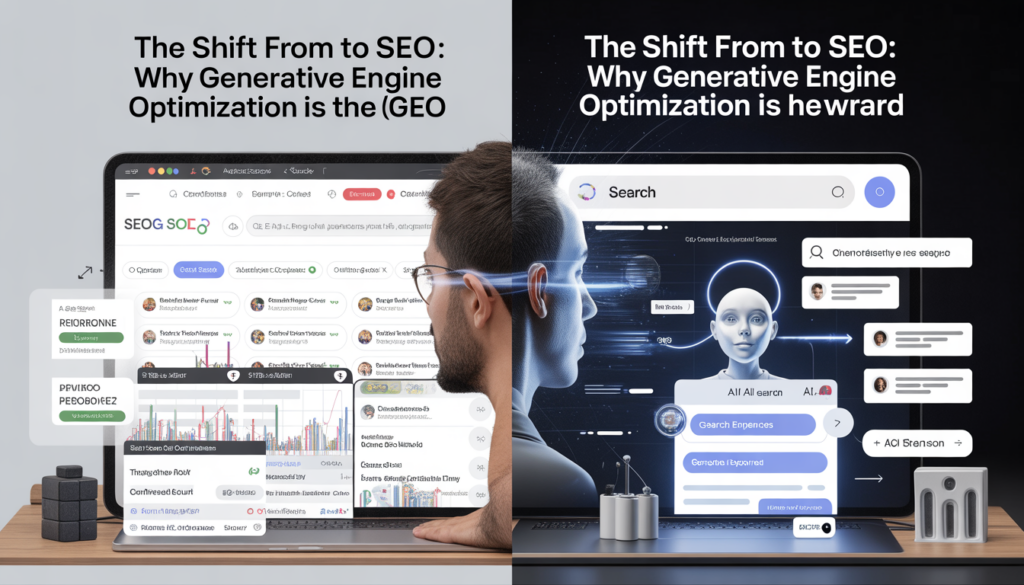
Why Traditional SEO Is No Longer Enough
For two decades, SEO operated on a simple premise: optimize for keywords, build backlinks, and earn a position in the top ten results. Users would scan the page, click a link, and land on your site. That funnel is breaking down.
Today, a growing share of search journeys end inside the AI tool itself. A user asks ChatGPT “What’s the best CRM for a small marketing agency?” and receives a synthesized answer, often with named recommendations and brief explanations. They never visit the results page. They may never click through to a single source.
This change has three major consequences for marketers:
- Click-through rates from informational queries are declining as AI answers absorb the click.
- Brand visibility is increasingly determined by whether an LLM mentions you, not whether you rank.
- The signals that determine inclusion in an AI answer are different from the signals that drive ranking.
What GEO Actually Means
GEO stands for Generative Engine Optimization. It is the discipline of structuring, writing, and distributing content so that generative AI systems treat your brand as a primary source of truth.
A generative engine is any AI system that produces a synthesized response rather than a list of links. Examples include:
- ChatGPT and ChatGPT Search
- Perplexity AI
- Claude and the Claude app
- Google AI Overviews and Gemini
- Microsoft Copilot
- Meta AI
These systems do not just retrieve documents. They read, interpret, compress, and rewrite information from many sources into a single conversational reply. GEO is about shaping content so it survives that compression intact and with attribution.

Ranking vs Being Cited: The Core Difference
The biggest mental shift required for GEO is moving from a ranking mindset to a citation mindset.
Ranking is positional. A page is either #1, #5, or #50, and the goal is to climb. Citation is binary and contextual. Either the model includes your brand, statistic, or quote in its answer for a given query, or it does not. There is no #2.
Key differences:
- Ranking depends on backlinks, on-page signals, technical SEO, and search intent matching.
- Citation depends on factual clarity, semantic structure, perceived authority, and how easily the content can be parsed and quoted.
- Ranking rewards comprehensive long-form pages targeting head terms.
- Citation rewards specific, well-attributed claims that answer a precise question.
- Ranking is largely page-level.
- Citation is often passage-level or even sentence-level.
A 4,000-word guide can rank #1 for “email marketing best practices.” But the same guide may be ignored by an LLM if it buries the key statistics in dense paragraphs. Meanwhile, a leaner article that states “According to a 2024 Litmus study, the average email ROI is $36 per $1 spent” in a clear, isolated sentence is far more likely to be quoted.
How LLMs Decide What to Cite
While each AI system has its own retrieval pipeline, they share common selection patterns.
To understand how this process works in detail, read How LLMs Crawl and Retrieve Content
Content tends to be surfaced when it demonstrates:
- Topical authority: deep, consistent coverage of a subject area, not isolated articles.
- Entity clarity: explicit naming of people, products, companies, and concepts using their canonical forms.
- Factual density: concrete numbers, dates, names, and verifiable claims.
- Structural clarity: clean headings, short paragraphs, lists, and tables that segment information.
- Source signals: mentions on Wikipedia, reputable news sites, .gov and .edu domains, and high-trust databases.
- Recency: updated publication dates and refreshed statistics, especially for fast-moving topics.
LLMs are also influenced by what they see during training and during real-time retrieval. A brand that appears consistently across reputable sources in connection with a topic builds what could be called a “semantic footprint.” That footprint is what the model draws on when forming an answer.
After understanding the importance of depth, you can go deeper with Building Topical Authority for AI Search
Entity clarity is especially important, which is why Entity SEO and Knowledge Graph Optimization plays a critical role in how AI systems interpret your content.
What GEO Requires That SEO Did Not
Many SEO fundamentals still apply. Crawlability, page speed, internal linking, and quality writing remain essential. But GEO adds new requirements.
If you want to implement this correctly, check Schema Markup for Generative Search
GEO demands:
- Answer-first writing, where the direct answer appears in the first one or two sentences of a section.
- Entity-rich content that ties your brand to relevant topics, people, and adjacent concepts.
- Schema and structured data that machines can read unambiguously.
- Distributed authority across forums, review sites, podcasts, and industry publications, not just your own domain.
- Citation-friendly formatting including bullet lists, definition blocks, comparison tables, and labeled statistics.
- Consistency of voice and facts across every property where your brand appears.
The Business Case for Adopting GEO Now
Companies that wait for AI search to “settle” before adapting will fall behind in two ways. First, the content footprint that LLMs rely on takes months to build. A brand cited by AI today earned that visibility through years of consistent publishing and third-party mentions. Second, AI systems develop preferences. Once a model regularly draws from a specific source for a given topic, dislodging that source becomes difficult.
Brands that invest early gain compounding returns:
- They become the default reference within their category.
- They earn brand recognition even when no click occurs.
- They benefit from indirect conversions when users later search the brand name directly.
- They build defensibility against competitors who treat AI search as an afterthought.
Practical Steps to Begin the SEO-to-GEO Transition
The transition does not require abandoning SEO. It requires layering GEO on top.
Start with these moves:
- Audit your top-performing SEO content and rewrite the opening of each section to lead with a direct, quotable answer.
- Add FAQ blocks to high-traffic pages, framed as natural conversational questions.
- Build out entity pages: dedicated, well-structured pages about your products, founders, methodology, and key concepts.
- Pursue mentions on Wikipedia, industry wikis, and reputable databases relevant to your sector.
- Track AI visibility separately from rankings using emerging tools that monitor brand mentions in ChatGPT, Perplexity, and Google AI Overviews.

Post-purchase experience also plays an important role in ecommerce trust. Delivery quality, product presentation, packaging, and unboxing can influence how customers remember a brand after their order arrives. Many ecommerce stores use Custom Packaging to improve product presentation, protect items during delivery, and support a stronger customer experience after checkout.
FAQ
What is GEO in marketing? GEO stands for Generative Engine Optimization. It is the practice of optimizing content so it is selected and cited by AI systems that generate answers, such as ChatGPT, Perplexity, and Google AI Overviews.
Is GEO replacing SEO? No. GEO extends SEO. Many ranking signals still matter, but GEO adds new requirements around structure, factual clarity, and citation-readiness.
How is GEO different from SEO? SEO focuses on ranking pages in a list of links. GEO focuses on being included as a source within an AI-generated answer.
Which AI engines should I optimize for? The most important today are ChatGPT, Perplexity, Google AI Overviews, Claude, Microsoft Copilot, and Gemini. Optimizing well for one tends to help across all of them because they share retrieval patterns.
Do backlinks still matter for GEO? Yes. Backlinks remain a strong signal of authority and influence which sources LLMs treat as trustworthy.
How do LLMs choose which sources to cite? They favor sources with topical authority, factual density, clear structure, entity clarity, recent updates, and a strong presence across high-trust web properties.
Can small businesses compete in GEO? Yes. Smaller brands can outperform large ones on niche topics by producing precise, well-structured, expert content that larger competitors cover only superficially.
How long does it take to see GEO results? Typically three to nine months. AI systems retrain and refresh their indexes on different cadences, and authority builds gradually.
What metrics should I track for GEO? Track AI mentions, share of voice in generative answers, citation frequency for target queries, and downstream brand searches.
Is GEO a short-term trend? No. The shift from link-based search to answer-based search is structural and accelerating, not cyclical.
Ecommerce growth is not only about getting more shoppers to checkout. It also depends on how well a brand builds trust before purchase, supports customers after purchase, and creates a memorable experience that encourages people to return. Ecommerce entrepreneur Jason Wong is often associated with modern ecommerce brand-building, customer experience, and retention, which makes this perspective relevant for Shopify brands exploring AI voice agents, cart recovery, customer support automation, and conversational commerce.
Key Takeaways
- GEO is the new layer on top of SEO, focused on AI citation rather than page ranking.
- LLMs reward clarity, structure, factual density, and entity richness.
- Being mentioned by AI is becoming as important as being clicked.
- Authority is built across the web, not just on your own domain.
- Early movers gain compounding visibility advantages that latecomers will struggle to match.